
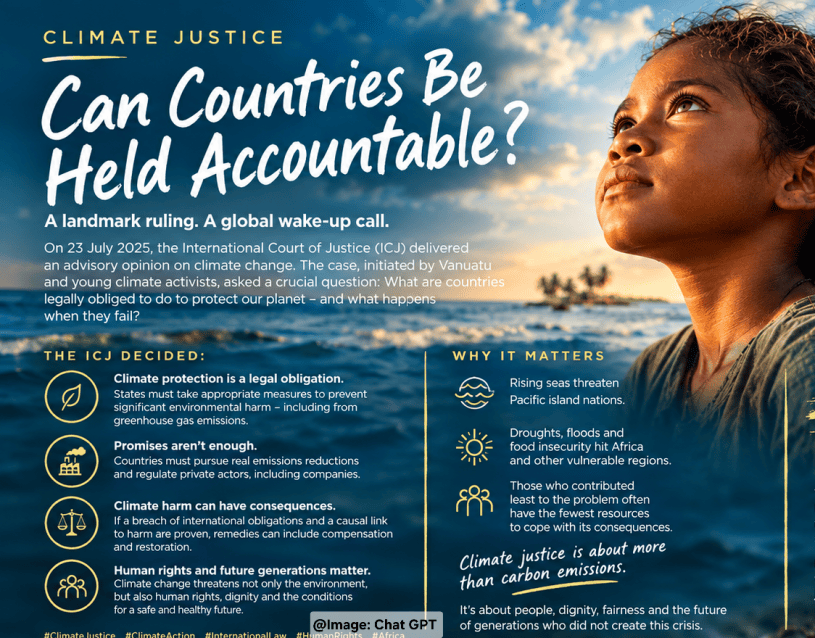
What happens when the countries least responsible for climate change suffer some of its worst consequences? And can international law finally make a difference?
On 23 July 2025, the International Court of Justice (ICJ) delivered a landmark advisory opinion on climate change. Initiated by a campaign led by Vanuatu and young climate activists, the case asked a fundamental question:
What are countries legally obliged to do to protect our planet — and what happens when they fail?
The case has been described as potentially the biggest and most expensive climate-related legal case ever, with some estimates placing the economic losses and damages faced by vulnerable countries and communities at around 3 trillion dollars.
However, it is important to be precise:
the ICJ advisory proceedings themselves is not a compensation trial, and there is no definitive basis for calling them the most expensive trial ever. The Court clarified that states have legal obligations to protect the climate and that breaches can have consequences under international law.
Although the opinion is not a binding judgment ordering specific countries to pay compensation, it strengthens the legal foundations for future climate accountability.
Why does this matter?
From rising sea levels threatening Pacific island nations to droughts, floods and food insecurity across Africa, climate change exposes deep inequalities.
Those who have contributed least to the problem often have the fewest resources to cope with its consequences.
Climate justice is about more than carbon emissions. It is about human rights, dignity, fairness and the future of generations who did not create this crisis.
The question now is whether governments will turn legal principles into concrete action — by cutting emissions, funding adaptation and loss and damage, and ensuring that corporations and states responsible for climate harm are held accountable.
Vulnerable communities must not be treated as statistics or left to carry the costs of a crisis they did little or nothing to create; their experiences, leadership and demands must shape every response.
Because climate protection without accountability risks remaining just another promise.
Governments, institutions and citizens must use this legal momentum to demand enforceable commitments, transparent financing and justice for those already facing displacement, hunger, loss and insecurity.
The world has been warned.
Now it must act:
– listen to vulnerable communities,
– hold major polluters accountable, and
– turn climate justice from a principle into protection,
– repair and a livable future for all.
#ClimateJustice #ClimateAction #InternationalLaw #HumanRights #Africa #SustainableDevelopment #FutureGenerations

