
By early 2025, the UN estimated that more than 12 million people had been forced from their homes, including roughly 8.8 million internally displaced people and more than 3 million refugees and asylum-seekers. The war has also killed tens of thousands of people; the World Health Organization reported that attacks and conflict had caused more than 28,000 deaths by the end of 2024, while noting that the true toll is likely far higher because many deaths go unrecorded.
What began as an internal power struggle has become deeply entangled with regional and international interests.
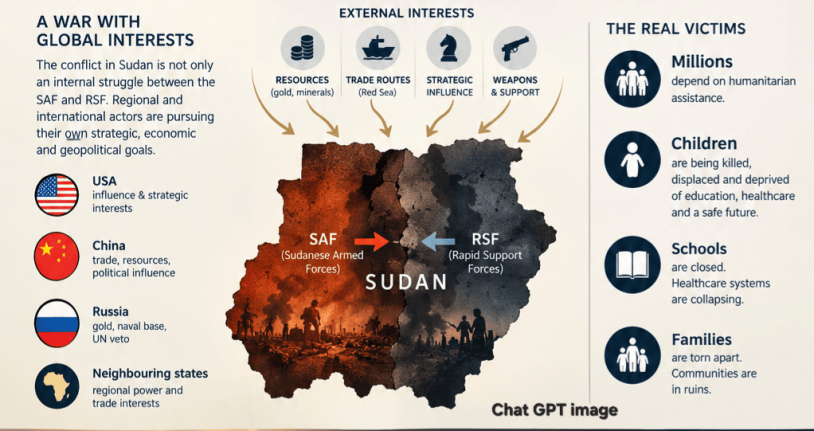
Russia, China, the United States and Sudan’s neighbouring countries all have their own strategic, economic or security interests in Sudan. These include access to resources such as gold and oil, trade routes, regional influence and the strategically important Red Sea.
Russia has pursued interests around Sudan’s gold and Red Sea access, including a potential naval facility. UN experts and investigative reporting have documented links between Russian networks and Sudan’s gold trade, while the U.S. Treasury has sanctioned entities connected to the Wagner network and gold exports. China seeks long-term economic and resource interests, while maintaining relations with Sudan’s authorities. The United States has imposed sanctions and engaged diplomatically, while also balancing broader strategic interests in the region. Neighbouring countries such as Egypt, Chad, Ethiopia and others are directly affected by – and in different ways involved in – the conflict. The UN and independent investigations have also reported allegations of weapons, drones, ammunition and other military support reaching the parties through regional networks, including routes linked to Libya, Chad and the United Arab Emirates; the UAE has denied arming the RSF.
But beyond geopolitics, one question must remain at the centre:
What about the people?
What about the children?
The UN’s 2025 humanitarian appeal estimated that more than 30 million people in Sudan — around two-thirds of the population — needed humanitarian assistance, including about 16 million children. The World Food Programme warned that more than 24 million people faced acute food insecurity, with famine confirmed in multiple areas and at risk of spreading. Children are being killed, displaced and deprived of education, healthcare and a secure future.
Humanitarian aid saves lives, that is a fact. But it cannot end a war.
As long as weapons, money and external interests continue to sustain the conflict, humanitarian organisations are forced to address the consequences rather than the causes.
Recent UN reporting, including the Panel of Experts on Sudan, and research by organisations such as Human Rights Watch and Amnesty International have highlighted the continued flow of foreign weapons, financing and logistics as a major factor sustaining the war.
In 2024, the UN Security Council also demanded that states stop external support contributing to the conflict and called for compliance with the arms embargo on Darfur.
Sudan needs quick and sustained support for local organisations and communities, alongside emergency and mobile education, healthcare, water, livelihoods and local economic opportunities.
And above all, the people of Sudan must be strengthened to rebuild their own country.
In my opinion the foundations for lasting change must ultimately come from within.
Sudan does not need our pity. Sudan needs the opportunity to recover, rebuild and be reborn.
Its children did not start this war.
They did not choose the weapons.
They did not choose the geopolitical interests surrounding their country.
Yet they are paying the highest price.
So perhaps the question is not only:
Can Sudan be saved?
But also:
Are we willing to create the conditions in which Sudanese people can rebuild their own future?
Because peace is more than the absence of war.
Peace means having a future worth living for.
And that future begins with the children.

